

Rethinking the Loom as an Architectural Instrument
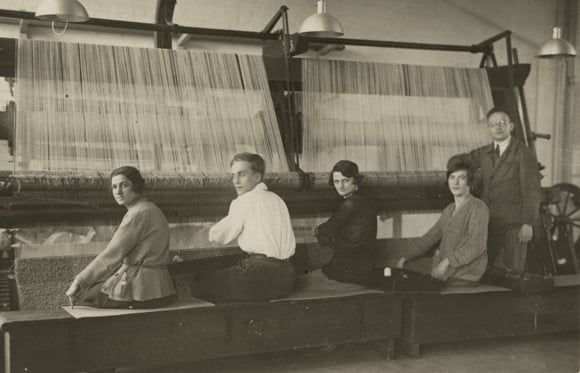
Look closely at a Bauhaus textile and the familiar story of institutional equality begins to unravel. The school”s rhetoric promised a modern community in which art, craft, and architecture would meet on equal terms, yet its admissions policy and workshop structure quickly exposed a more conventional hierarchy. Walter Gropius initially pledged equal access for women and men, but female students were soon directed away from painting, sculpture, and architecture toward disciplines considered more suitably feminine. This pattern is extensively documented in accounts of the Women of the Bauhaus, whose achievements emerged within, and frequently against, these restrictions.
The weaving workshop should therefore not be mistaken for a domestic refuge at the margins of modernism. It became an intellectual laboratory in which color, rhythm, surface, material behavior, and spatial organization were tested with exceptional discipline. Gunta Stölzl and Anni Albers transformed pliable threads into a form of architectural thinking. Their fabrics did not merely decorate rooms. They modulated light, absorbed sound, organized walls, suggested movement, and proposed new relationships between the body and modern space. The loom became less a symbol of tradition than an instrument for examining how structure could be made visible, tactile, and inhabitable.
Subverting the Gendered Craft Trap in Weimar and Dessau
The prejudice surrounding textile work was inseparable from a wider cultural distinction between “fine art” and “craft.” Painting and sculpture were associated with individual genius, autonomy, and public ambition, while textiles were linked to utility, domestic labor, and feminized skill. Such categories were never neutral. They reflected assumptions about gender and class, deciding in advance which materials could carry intellectual authority. At the Bauhaus, women who might have pursued architecture or painting often encountered an institutional barrier disguised as practical guidance: weaving was presented as their natural destination.
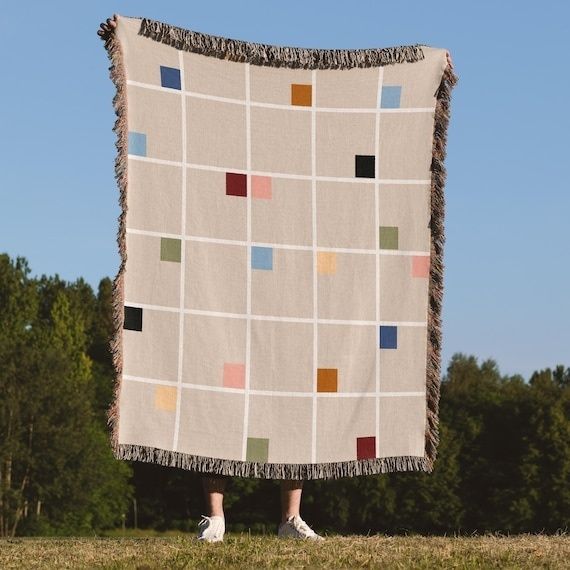
That limitation nevertheless produced an unexpected concentration of talent. The early weavers did not simply reproduce picturesque scenes on traditional tapestries. They investigated the grid as a system. Warp and weft became coordinates, intervals, and vectors through which a composition could be built rather than illustrated. The textile”s meaning resided increasingly in its structure, in the tension between horizontal and vertical lines, the density of a passage, the interruption of a rhythm, or the optical vibration produced by adjacent colors.
This shift can be understood as a movement from inherited folk craft toward systematic spatial design. The workshop respected manual knowledge, but it also subjected that knowledge to analysis, testing, and industrial ambition. Weavers explored how a surface might function within a building rather than merely hang upon it. In this context, craft was not the opposite of modernity. It was a means of examining modernity at close range.
- The grid became a compositional framework rather than a decorative border.
- Material choice was treated as a technical decision with optical and acoustic consequences.
- Repetition created rhythm, while variation prevented the surface from becoming mechanically inert.
- The textile was increasingly designed in relation to architecture, furniture, light, and human movement.
Gunta Stölzl and the Mastery of Color and Complex Weave
Gunta Stölzl”s career reveals how a woman working inside a restricted department could reshape the institution itself. She enrolled at the State Bauhaus in Weimar in 1919 and eventually became the first female master at the Bauhaus in Dessau, as well as the school”s only woman to hold that status. Her authority was not symbolic. Under her direction, the weaving workshop became one of the Bauhaus”s most productive and technologically progressive departments, linking experimental design to commercial production.
Stölzl”s drawings and watercolours offer a valuable key to her method. Their color fields, directional marks, and carefully controlled intervals suggest that she approached the textile as an elevation, a plan, or a diagram of forces. The warp and weft were not passive supports for an image; they were active structural agents. Notice the way a color may advance, recede, or alter the apparent weight of a neighboring passage. Such effects demonstrate that Stölzl understood color not as surface ornament but as a spatial instrument.
Her practice also demonstrates the importance of translation. A drawing or watercolour could serve as a conceptual score, but the finished fabric had to negotiate the resistance of fibers, the limits of the loom, and the requirements of production. The workshop increasingly developed prototypes for modern interiors, including fabrics capable of functioning across furnishings and architectural surfaces. Stölzl”s preserved studies and textile drafts, now represented in the collections of Das Bauhaus-Archiv / Museum für Gestaltung, make visible the passage from abstract idea to material construction.
Anni Albers and the Material Engineering of Modern Space
Anni Albers pushed the architectural potential of weaving even further by asking what a textile could do in a room. Her diploma project was a wall covering for an auditorium designed to reflect light on one side and absorb sound on the other. The proposal was radical because it treated textile performance as part of architectural planning. The wall covering was not simply an image placed inside the auditorium. It was a responsive surface, designed to influence illumination, acoustics, and the sensory experience of an audience.
Albers”s experiments challenged the assumption that textile value depended on natural fibers and inherited technique. She worked with synthetic materials, cellophane, metallic threads, and other unconventional substances, observing how each altered reflection, texture, weight, transparency, or sound. The loom became a testing ground for material engineering. A thread could catch a beam of light, interrupt a visual field, stiffen a surface, or introduce a faintly metallic vibration into an otherwise quiet composition.
Traditional handicraft often emphasizes continuity, touch, and the singularity of the handmade object. Albers retained the intelligence of touch but directed it toward reproducibility and industrial mass production. She did not regard mechanization as the enemy of artistic thought. Instead, she asked how carefully conceived designs could enter everyday environments without losing their structural and sensory intelligence. Her writing and teaching helped recast weaving as a discipline connected to engineering, architecture, and systems of communication.
| Textile concern | Traditional expectation | Albers”s modern proposition |
|---|---|---|
| Material | Natural fibers and established methods | Synthetic fibers, cellophane, metallic threads, and experimental combinations |
| Function | Decoration or domestic furnishing | Light reflection, sound absorption, spatial division, and visual orientation |
| Production | Individual handmade object | Design suitable for industrial adaptation and wider access |
| Meaning | Pattern, ornament, or inherited motif | Structure, sign, rhythm, material behavior, and architectural communication |
A New Framework for Modern Spatial Theory
The decisive change within the workshop was not simply a preference for abstraction. It was a change in the status of the textile itself. A pictorial tapestry generally presents an image on a woven ground, whereas an industrial architectural textile allows the material structure to generate visual and spatial effects. The difference is subtle but consequential. In the latter case, the textile is not a secondary illustration of an architectural idea. It becomes an active component of the building”s atmosphere and organization.
Tactile wall coverings, curtains, screens, and acoustic surfaces offered modern architects a way to soften the severity of open-plan interiors without returning to historical ornament. They could divide space temporarily, control privacy, temper reverberation, and introduce color without permanently altering a wall. The Bauhaus weavers thus helped establish principles that remain relevant to contemporary interiors and collectible design.
- Structure can become ornament. The grid, weave, and junction are visually expressive when their construction is allowed to remain legible.
- Material is an active agent. Fibers influence light, sound, transparency, weight, and the movement of the body through a room.
- Design operates across scale. A small sample can contain the logic of a wall, curtain, partition, or complete interior.
- Repetition requires variation. Modern order gains vitality through shifts in density, color, texture, and rhythm.
- Utility does not diminish artistic ambition. A textile can serve a practical purpose while carrying complex formal and cultural meaning.
Living with the Tactile Legacy of Bauhaus Innovation
Contemporary exhibitions have made it increasingly difficult to maintain a rigid hierarchy between fine art and applied craft. Museum retrospectives, archival donations, and renewed scholarship now present Bauhaus textiles as central documents of modernism rather than supplementary evidence of domestic production. This change in framing matters because context shapes interpretation. A woven work should be judged not only by its surface resemblance to painting, but also by its technical decisions, material intelligence, spatial ambition, and relationship to the history of design.
For collectors and design enthusiasts, careful looking begins with the object”s construction. Examine the density of the weave, the regularity or disruption of the grid, the behavior of reflective fibers, and the relationship between color and texture. Establish provenance, dimensions, condition, and conservation history, especially because light-sensitive fibers and mixed materials can require specialized care. Study the work alongside drawings, samples, publications, and architectural commissions when possible. Such comparisons reveal whether a textile was conceived as a unique artwork, a prototype, or part of a broader production program.
The enduring achievement of the Bauhaus weavers lies in their refusal to let material determine status. They constructed the aesthetic backbone of many mid-century interiors and anticipated contemporary interests in acoustic design, adaptable space, sustainable making, and multisensory architecture. Stölzl demonstrated how color and complex weave could become a language of modern form. Albers showed that a textile could behave as an instrument of light, sound, structure, and thought. Their legacy is therefore not confined to the loom. It lives wherever surfaces organize experience and where design is understood as a meeting point between the hand, the machine, and the inhabited world.