

Carving Meaning into the Earth
Land Art began with a decisive refusal: the artwork did not need to remain inside the white cube. In the late 1960s, artists moved into deserts, salt flats, quarries, and other expansive terrains, treating rock, soil, water, distance, and weather as active materials rather than passive scenery. The gesture was both formal and political. It challenged the commercial gallery system and modernist sculpture while responding to a period marked by political upheaval, industrial expansion, and an emerging awareness of ecological fragility.
Look closely at the most influential earthworks and a productive contradiction appears. These works sought to expose the limits of industrial power, yet some required bulldozers, trucks, surveying equipment, and considerable logistical organization. Their monumental scale made geological time visible, but also made human intervention impossible to ignore. The central question for Land Art in the Anthropocene is therefore not simply how much land an artist can alter, but what kind of relationship the work proposes. Does the landscape become a conquered surface, a record of entropy, or a living collaborator? Contemporary practice increasingly answers through regenerative and ephemeral gestures rather than heroic permanence.
Monumental Ambitions and Industrial Machines
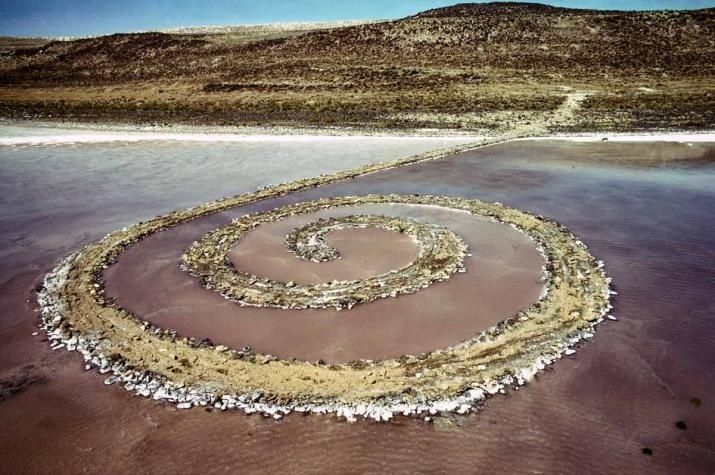
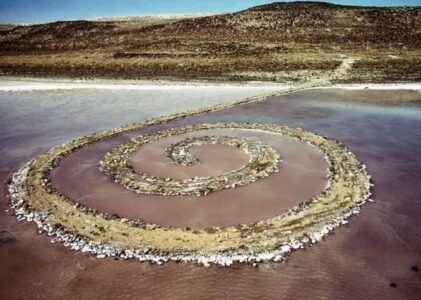
The early American pioneers of Land Art expanded sculpture until it became inseparable from geography. Robert Smithson”s Spiral Jetty, constructed in 1970 at Rozel Point in Utah”s Great Salt Lake, coils outward through dark water and basalt rock. Its shape is immediately legible from above, yet its meaning changes with water levels, algae, salt crystallization, and atmospheric conditions. Smithson selected the site partly because of its barren expansiveness and its proximity to abandoned oil rigs and the Golden Spike monument, reading those industrial remnants as entropic residues. The physical jetty is only one part of the work; Smithson”s essay and film extend it into language, image, and moving time.
Michael Heizer pursued a different kind of spatial drama. In Double Negative, two monumental cuts interrupt the Nevada desert, producing an absence that is as forceful as any constructed object. His later City extends this ambition across a remote Great Basin valley. The work uses locally collected clay, sand, and rock, and its isolation is essential to the experience. Yet the project also reveals the practical complications of monumental Land Art. It occupies private property, requires controlled access, and is surrounded by a landscape whose cultural history includes the ancestral territories of the Nuwu and Newe peoples. Walter De Maria”s The Lightning Field, completed in 1977, replaces excavation with repeated vertical precision: four hundred stainless-steel poles establish a measured field in western New Mexico, where changing light and weather activate the geometry.
The philosophical paradox is difficult to avoid. Diesel-powered machinery helped artists criticize industrial domination, even as those machines physically inscribed the critique. This tension does not invalidate the works, but it does shape their historical significance. They are objects of resistance made through the resources of the system they questioned. Their scale also continues to influence collecting and curatorial practice, since ownership may involve land stewardship, access protocols, legal protection, and long-term environmental monitoring rather than acquisition of a portable object.
- Spiral Jetty uses basalt rock, earth, and water in a coil that accepts submergence and exposure, emphasizing entropy, geological duration, and industrial remnants.
- Double Negative uses excavation and absence on a vast desert site, turning the removal of material into an encounter with perception and spatial scale.
- City combines clay, sand, rock, and monumental architectural forms across a remote Nevada valley, pursuing a slow, quasi-civilizational image of sculpture.
- The Lightning Field uses four hundred stainless-steel poles and an unobstructed horizon, making light, weather, land ownership, and visitor management part of the work”s continuing medium.
The Archaeology of Landscape Intervention
Modern earth sculpting did not invent the idea that land can carry cultural meaning. Across millennia, communities have shaped terrain through mounds, enclosures, ceremonial platforms, roads, agricultural terraces, and burial landscapes. These structures differ profoundly from postwar Land Art in purpose and social context, yet the comparison is valuable. Both reveal that geography is never merely natural. It is also historical, symbolic, inhabited, and contested.
Indigenous mound structures should not be treated as primitive equivalents of modern sculpture. Many are sacred places, connected to burial, ceremony, ancestry, and collective identity. In Indiana alone, a state inventory documented 1,183 sites containing at least 2,100 individual earthworks, while also noting that many records were incomplete, poorly located, damaged, or based on reports rather than systematic field investigation. The Indiana mounds and earthworks inventory demonstrates why visual resemblance is not enough. Interpretation must include community knowledge, archaeology, legal protection, and the living cultural significance of the site.
For curators and collectors, this history establishes an ethical threshold. Documentation should record not only dimensions and materials, but also land tenure, Indigenous connections, archaeological sensitivity, and the effects of access. Regional stewardship initiatives can combine field verification, standardized mapping, public education, and preservation assessment; the Guidelines: Sustaining Battlefield Earthworks (U.S. National Park Service) offer a related model for coordinating site care. Such work is not ancillary to the artwork”s meaning. It determines whether a landscape intervention is understood as a responsible cultural act or as another episode in the long history of extracting value from land.
Entropy and the Evolving Discipline of Land Management
Smithson”s concept of entropy remains one of the most useful tools for reading Land Art. In Spiral Jetty, decay is not a maintenance failure waiting to be corrected. Water, salt, sediment, and weather alter the work, and those changes belong to its visual and conceptual life. The spiral may disappear and re-emerge, making the artwork a record of unstable conditions rather than a fixed form. This approach conflicts with conservation models that seek to preserve an original appearance, but it also anticipates the Anthropocene”s difficulty: environmental change can no longer be treated as a distant backdrop.
The Lightning Field makes the problem more explicit. Its poles depend on an apparently open and isolated setting, so nearby development threatens not only the view but the work”s intended experience. Conservation easements, land purchases, visitor protocols, staff mediation, documentation, and concealed infrastructure have therefore become part of the artwork”s ongoing reality. What stands out here is the transformation of preservation into artistic practice. The work is no longer only a field of steel; it is also a legal, ecological, and institutional system that must negotiate property rights, climate pressure, public access, and the financial structures of conservation.
This expanded understanding of care connects contemporary sculpture with historic battlefield preservation. Erosion is often the greatest threat to earthen forms, whether those forms are centuries-old ceremonial mounds, nineteenth-century military parapets, or modern excavated geometries. The National Park Service guidelines for sustaining battlefield earthworks emphasize integrated natural and cultural resource management, healthy vegetative cover, minimal intervention, and the value of established native plants under changing climate conditions. For land-based art, such principles encourage a shift from restoring an imagined original surface toward managing the processes that keep the site legible and ecologically resilient.
| Earthwork type | Primary preservation challenge | Useful stewardship emphasis |
|---|---|---|
| Indigenous mounds and enclosures | Archaeological damage, construction, unauthorized digging, and loss of cultural context | Community consultation, accurate documentation, legal protection, and restricted access where appropriate |
| Historic battlefield earthworks | Erosion, vegetation loss, compaction, and changing land-use pressures | Native plant cover, careful visitor management, and coordinated natural and cultural resource planning |
| Modern excavated earthworks | Weathering, altered drainage, infrastructure failure, and uncertainty about intended change | Artist or estate records, condition monitoring, and conservation policies that distinguish entropy from damage |
| Large remote installations | Development, fragmented ownership, climate change, and limited public access | Land acquisition, conservation easements, transparent governance, and long-term environmental assessment |
The 21st-Century Shift Toward Regenerative and Ephemeral Gestures
Contemporary Land Art increasingly moves away from the image of the artist as a solitary engineer commanding a desert. The field now includes ecological art, bio-art, environmental performance, community-based practice, and projects in which the artist”s most important action is to enable recovery. University curricula that trace Land Art from the Earthworks of the late 1960s through present ecological practices reflect this widening definition. The medium may be soil health, microbial activity, watershed repair, native planting, or the social organization required to care for a threatened habitat.
These works often resist the collector”s traditional desire for permanence. A project may remediate contaminated soil, restore a wetland, support pollinators, or use living organisms to filter polluted water. Its success may be measured through improved ecological function rather than visual stability. Other works are deliberately temporary, designed to dissolve, decompose, migrate, or be absorbed by seasonal processes. The disappearance is not a lack of ambition. It can be a carefully structured refusal of the assumption that artistic value depends on lasting physical possession.
The conceptual pivot is from dominance to reciprocity. Instead of treating geology as an empty canvas, regenerative practice recognizes that land has agency expressed through growth, erosion, hydrology, animal movement, and chemical transformation. This does not make human intervention innocent. Any ecological artwork still raises questions about permission, unintended consequences, labor, maintenance, and whose knowledge defines restoration. It does, however, make those questions visible within the form of the work.
- Soil-based practice may focus on composting, replanting, fungal networks, or the gradual rebuilding of fertile ground.
- Water-oriented projects can address filtration, wetland recovery, riverbank stabilization, and public awareness of watershed systems.
- Ephemeral interventions use biodegradable materials, seasonal arrangements, or natural succession so that disappearance becomes part of the composition.
- Participatory stewardship places local communities, scientists, farmers, and Indigenous knowledge holders alongside artists as co-producers of meaning and care.
Living with the Marks We Leave Behind
The trajectory of Land Art leads from heroic permanence toward conscious duration. Smithson”s spiral, Heizer”s cuts, and De Maria”s calibrated field remain powerful because they make scale, time, and human ambition visible. Their contradictions are equally important. They expose the machinery behind the gesture, the institutional systems required to protect remote sites, and the historical narratives that monumental abstraction can conceal. Contemporary regenerative work does not erase this legacy; it argues with it.
For viewers and collectors, the most revealing question is not whether an environmental artwork looks monumental. Ask instead what the work asks the land to do, what the land is allowed to do in return, and how care is organized over time. A landscape may be the material, archive, collaborator, and stakeholder all at once. In the Anthropocene, the strongest Land Art does not simply leave a mark behind. It teaches attention to the marks already present, including geological change, cultural memory, ecological damage, and the possibility of repair.